 mehul.pattel
2026 Tech Trends: How Spatial Computing and Quantum Supremacy Are Rewriting Reality
TL;DR (Key Takeaways):
- Spatial Computing is Mainstream: The death of the traditional monitor. AR/VR headsets like the Apple Vision Pro Gen 3 have replaced 30% of corporate multi-monitor setups.
- Quantum Leap: Commercial Quantum-as-a-Service (QaaS) is now accessible to mid-size enterprises, breaking traditional encryption and revolutionizing material science.
- Agentic AI Workforce: AI is no longer a tool; it is a co-worker. Over 40% of B2B software tasks are now completely autonomous.
- Sustainable Tech: Due to AI’s massive energy consumption, tech giants have pivoted to ultra-efficient photonic chips and localized small modular nuclear reactors (SMRs).
1. Introduction: The Year the Future Arrived
If the early 2020s were defined by the sudden explosion of Generative AI, then 2026 will be remembered as the year these disconnected technologies finally converged into a cohesive, everyday reality. We are no longer talking about “what could happen in five years.” The future is being deployed into production today.
The boundaries between physical and digital spaces have collapsed (Spatial Computing), the fundamental limits of processing power have been shattered (Quantum Computing), and software has evolved from a static tool into an autonomous workforce (Agentic AI). In this massive 2026 Tech Trends report, we break down the technological paradigms that are reshaping global economies, enterprise infrastructure, and consumer behavior.
2. Spatial Computing: The Death of the Monitor
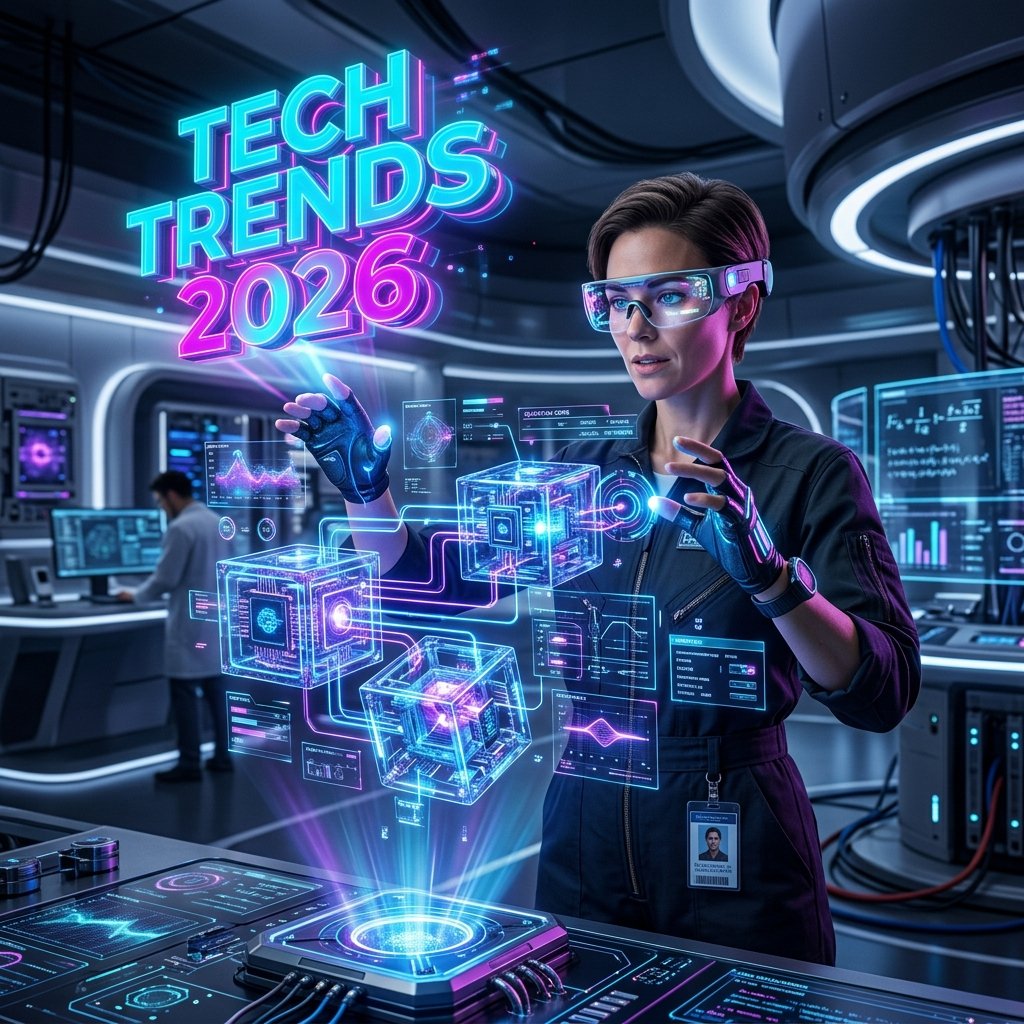
The concept of “screen time” is becoming obsolete as we move into a world of “spatial time.” Spatial computing—the seamless blending of digital interfaces with the physical world—has officially crossed the chasm from an enthusiast novelty to an enterprise necessity.
The Hardware Evolution
The bulky, heavy VR headsets of 2023 are a distant memory. The 2026 iterations of Spatial Computers (led by Apple, Meta, and new entrants from Google and Samsung) resemble slightly thick designer sunglasses. They feature micro-OLED displays with true retinal resolution, eliminating the “screen door effect” entirely.
The Enterprise Office
The biggest impact has not been in gaming, but in the B2B sector. Financial traders, software engineers, and architects no longer sit in front of six plastic monitors. Instead, they put on their glasses and manifest infinite virtual workspaces in the air around them. This has drastically reduced commercial real estate needs, as a “perfect office setup” now fits in a briefcase.
3. Quantum Computing: From the Lab to the Cloud
For decades, quantum computing was a theoretical physics experiment locked in ultra-cold cryogenic chambers. In 2026, Quantum-as-a-Service (QaaS) is commercially available via AWS, Azure, and Google Cloud. While we haven’t reached full universal fault-tolerance, the current generation of quantum processors can solve specific problems millions of times faster than classical supercomputers.
| Industry | Classical Computing Limitation | 2026 Quantum Breakthrough |
|---|---|---|
| Pharmaceuticals | Simulating complex protein folding took months or years. | Simulates molecular interactions in hours, discovering novel drug compounds instantly. |
| Logistics | The “Traveling Salesman Problem” for thousands of global shipping routes was impossible to perfectly optimize. | Calculates the absolute most efficient global supply chain route, saving billions in fuel. |
| Cybersecurity | RSA-2048 encryption is practically unbreakable. | Shor’s algorithm implementation threatens legacy encryption, forcing a global panic-migration to Post-Quantum Cryptography (PQC). |
4. The Agentic AI Workforce
We have moved past conversational AI. You no longer ask an AI to “Write a python script to scrape data.” In 2026, you give an Agentic AI a high-level goal: “Build a profitable e-commerce business selling sustainable dog toys, manage the supply chain, handle customer service, and report back to me on Friday.”
These autonomous agents operate inside complex digital ecosystems. They communicate with other AI agents via API, negotiate software licenses, and write their own code to overcome obstacles. This has caused a massive shift in human employment. The role of humans in the tech sector has pivoted from “Creators” to “Editors and Overseers.”
5. Sustainable Tech and the Energy Crisis
The dirty secret of the AI and Quantum revolution is the sheer amount of electricity it consumes. Training a next-generation LLM in 2026 requires the energy equivalent of a small city. This energy crisis forced the tech industry to innovate rapidly in sustainability.
- Photonic Computing: The transition from electronic chips (using electrons) to photonic chips (using light/photons). Photonic chips are 100x faster and consume 90% less energy, eliminating the massive heat dissipation problem in data centers.
- Small Modular Reactors (SMRs): Major tech giants like Microsoft and Amazon are no longer relying on the national grid. They are deploying proprietary, safe, localized nuclear micro-reactors directly on-site to power their AI data centers.
6. The Brain-Computer Interface (BCI) Frontier
While still in its nascent commercial stages, non-invasive BCIs have hit the consumer market in 2026. Taking the form of stylish headbands or neural-integrated earbuds, these devices read EEG signals to allow users to type, control spatial computing interfaces, and even interact with their smart homes using only their thoughts. While invasive implants (like Neuralink) remain strictly in the medical domain for treating paralysis, non-invasive “thought-to-text” is the fastest-growing tech accessory of the year.
7. Conclusion: Adapting to the Velocity of Change
The pace of technological advancement in 2026 is exponential. The companies and individuals who thrive will not be those who try to compete with these technologies, but those who learn to orchestrate them. Spatial computing provides the canvas, quantum provides the raw power, and agentic AI provides the workforce. We are no longer just using technology; we are collaborating with it.
Frequently Asked Questions (FAQ)
Is my data safe from Quantum Computers?
Yes and no. Any encrypted data stolen today (the “harvest now, decrypt later” attack) will likely be cracked by quantum computers in the near future. However, major tech platforms have already transitioned your live data to Post-Quantum Cryptography (PQC) standards.
Will Spatial Computing completely replace my smartphone?
Not immediately. In 2026, the smartphone acts as the hidden computational engine and cellular hub in your pocket, while the AR glasses act as your display and interface.
How can small businesses afford Agentic AI?
Just like cloud computing democratized server access in the 2010s, AI is democratized via AI-as-a-Service (AIaaS). Small businesses can rent autonomous agents for a few dollars an hour, gaining the productivity of a Fortune 500 team.