 mehul.pattel
Agentic Payment Layers: How AI and Blockchain Are Revolutionizing B2B Finance in 2026
The intersection of Artificial Intelligence (AI) and enterprise software has been the driving force of the global economy for the past five years. However, as we move through the second half of 2026, a massive new battleground has emerged in the financial technology (FinTech) sector: “Agentic Payment Layers.”
Global payment processing giants, including Visa, Mastercard, Google, and Ripple, are currently racing to deploy autonomous AI agents capable of negotiating, authorizing, and settling cross-border transactions without human intervention. This monumental shift in business-to-business (B2B) payments is not just a technological marvel; it represents a multi-trillion-dollar opportunity in cloud computing, cybersecurity, and enterprise finance.
In this comprehensive analysis, we will explore what Agentic Payment Layers are, why corporate enterprises are eagerly adopting them, and how blockchain technology acts as the essential backbone for this financial revolution.
🧠 What is an “Agentic Payment Layer”?
To understand the magnitude of this shift, we must first define “Agentic AI.” Unlike traditional AI, which merely answers questions or generates text, an Agentic AI (or Autonomous Agent) acts on behalf of the user to complete complex, multi-step tasks.
When applied to the financial sector, an Agentic Payment Layer is a software infrastructure where corporate AI agents communicate directly with vendor AI agents to handle the entire lifecycle of a transaction.
How it Works (The 2026 Workflow):
- Procurement: A company’s inventory AI detects a shortage of raw materials.
- Negotiation: The AI agent automatically contacts multiple supplier AI agents, negotiating the best bulk price in real-time.
- Execution & Settlement: Once terms are agreed upon, the AI generates a smart contract. Upon delivery verification, the AI instantly releases funds across borders, utilizing blockchain for immediate settlement.
This completely eliminates the traditional friction of invoicing, manual approvals, currency conversions, and wire transfer delays.
💳 The Corporate Race: Visa, Mastercard, and Google
The transition to autonomous payments threatens the traditional revenue models of credit card networks and banks. To survive, these giants are aggressively pivoting to become the infrastructure providers for AI transactions.
1. Visa & Mastercard’s AI Networks
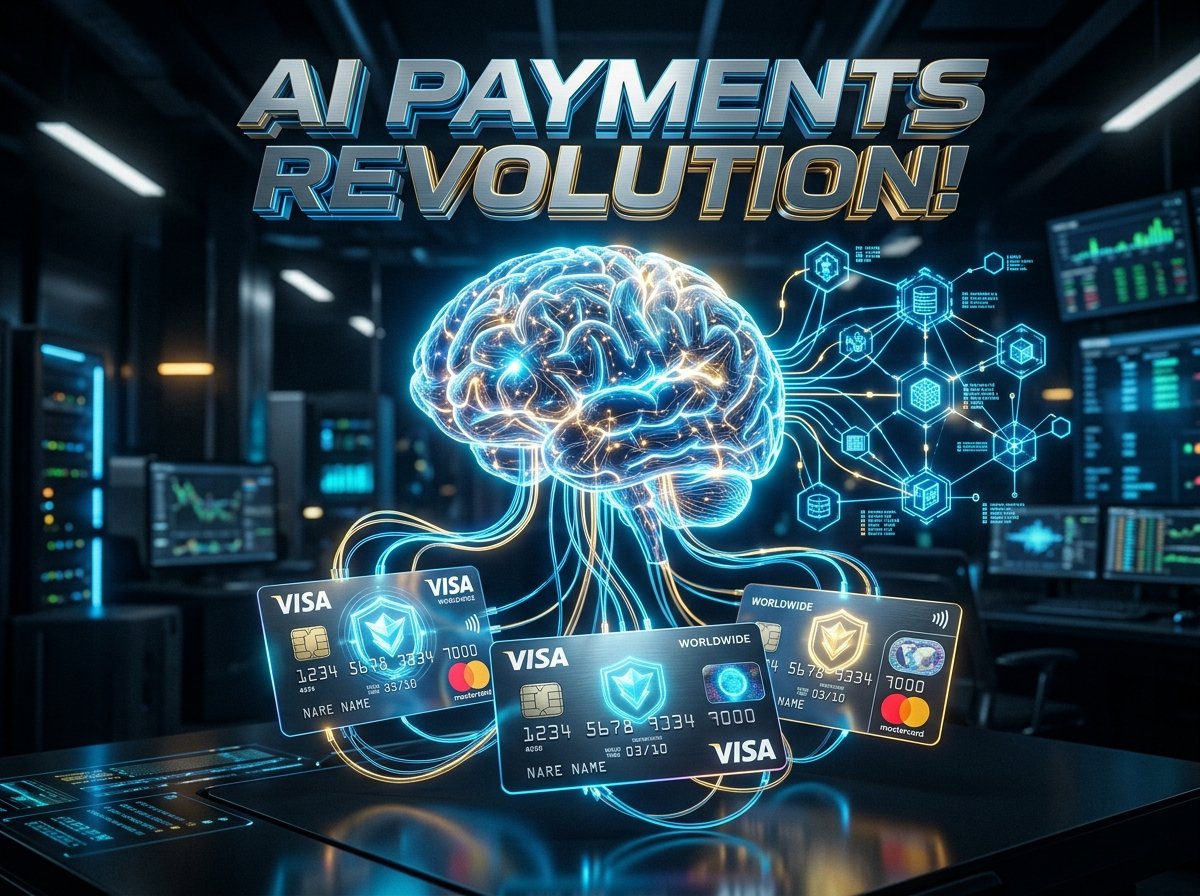
Both Visa and Mastercard have recently unveiled proprietary Application Programming Interfaces (APIs) designed exclusively for AI agents. Rather than issuing plastic credit cards to humans, these companies are issuing “Virtual Corporate Identities” to AI bots.
These virtual identities come with dynamically adjusted credit limits, fraud detection algorithms, and real-time transaction monitoring. If an AI agent attempts to make a purchase that violates corporate policy, the payment network’s overarching cybersecurity protocols instantly block the transaction.
2. Google’s Cloud Computing Dominance
Google has taken a different approach, leveraging its dominance in cloud infrastructure. By integrating payment gateways directly into its Google Cloud AI ecosystem, enterprise clients can build autonomous procurement bots that have native access to global payment rails. This seamless integration makes Google a formidable player in the B2B SaaS (Software as a Service) industry.
3. Ripple and the Blockchain Backbone
While AI provides the brain, blockchain provides the trust. Financial institutions are increasingly relying on companies like Ripple (XRP) and the newly launched Canton Network to settle these AI-driven transactions. Because AI operates at lightning speed, traditional banking systems (which can take days to clear international wire transfers) are a bottleneck. Blockchain enables instant, cryptographically secure cross-border settlements with near-zero transaction fees.
🛡️ The Crucial Role of Cybersecurity
With AI agents moving billions of dollars autonomously, cybersecurity has become the highest priority for Chief Information Security Officers (CISOs) globally. The rise of Agentic Payments has triggered a massive boom in the cybersecurity software market.
Protecting the AI Wallet
Hackers are no longer just trying to steal human passwords; they are attempting to execute “Prompt Injection Attacks” against corporate AI agents. If a hacker can trick an autonomous agent into authorizing a fraudulent invoice, the funds could vanish instantly across a decentralized blockchain.
To combat this, enterprise security firms are deploying “Zero-Trust AI Architectures.” Under this model, an AI agent must continuously cryptographically prove its identity and authorization level before executing any financial command. Furthermore, transactions above a specific risk threshold are automatically routed to human compliance officers for final approval.
📈 Economic Impact and B2B SaaS Investments
The deployment of Agentic Payment Layers is completely reshaping corporate balance sheets. By automating accounts payable and receivable, multinational corporations are slashing administrative costs by up to 40%.
For investors, this trend highlights a massive opportunity in the following high-growth sectors:
* Cloud Computing Infrastructure (IaaS): The computational power required for millions of AI agents negotiating in real-time is driving massive demand for cloud servers.
* B2B Fintech & Smart Contracts: Startups providing audit capabilities and legal frameworks for AI-to-AI smart contracts are seeing record venture capital funding.
* Cybersecurity: Companies specializing in AI behavior monitoring and threat detection are experiencing unprecedented revenue growth.
Conclusion
The era of manual B2B payments is rapidly coming to an end. As Visa, Mastercard, Google, and blockchain innovators build the next-generation digital economy, Agentic Payment Layers will become as fundamental to modern business as the internet itself.
For enterprise leaders and software developers, adapting to this AI-driven financial ecosystem is no longer optional—it is a mandatory requirement for survival in the 2026 global market.
Disclaimer: This article provides industry analysis on enterprise software and financial technology. It does not constitute financial or investment advice. Always consult with certified professionals before making corporate infrastructure investments.